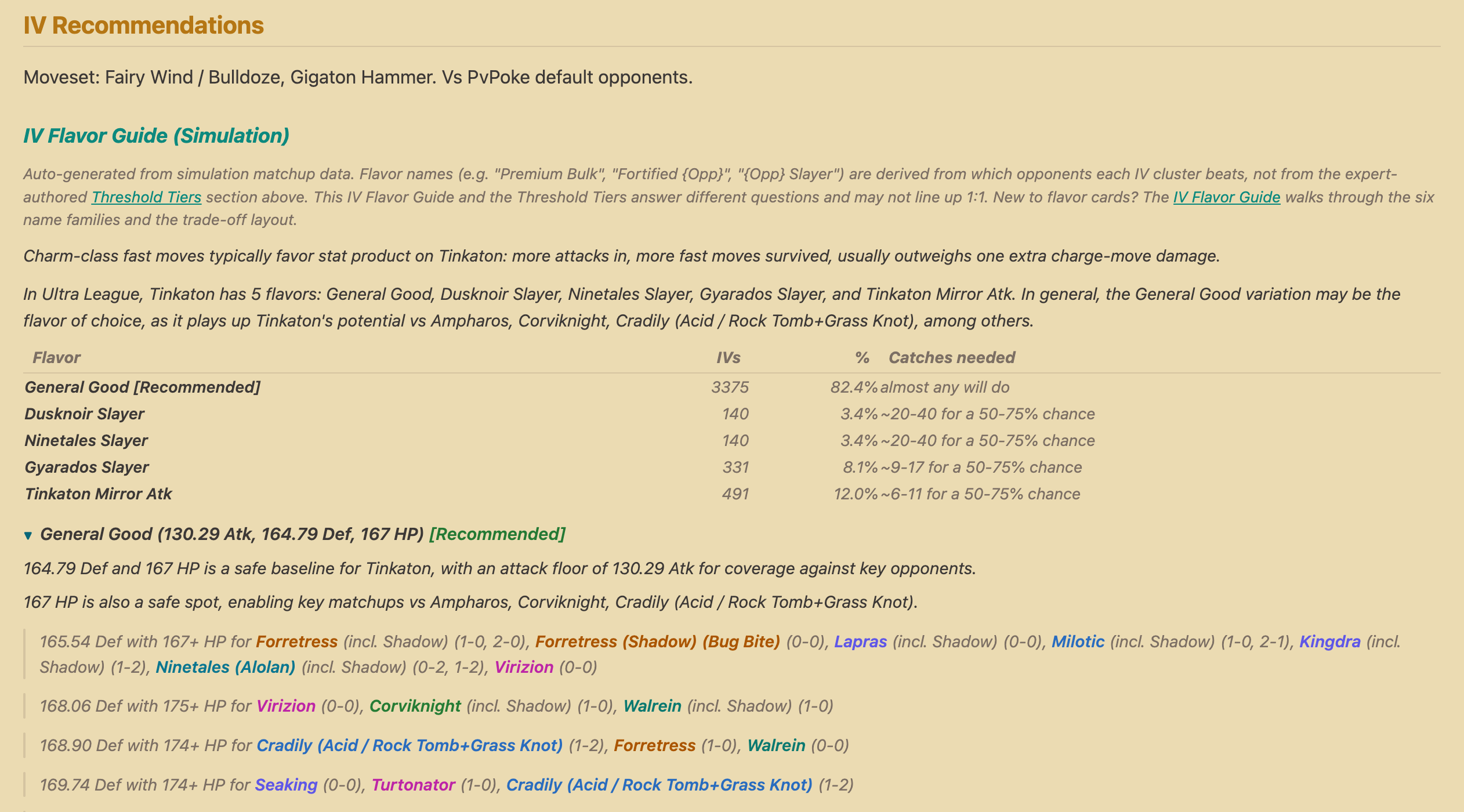
The IV Flavor Guide is the teal-bordered zone at the top of the IV Recommendations section on every dive page. It groups the IV space into a short list of named play-style archetypes - a “flavor” - each one paired with the specific matchups that flavor buys you and the specific matchups it costs.
It’s the fastest section to read on the whole page, and it’s the right place to start if you’re deciding which IV spread to chase.
A flavor is a named cluster of IV spreads with a shared stat signature and a shared strategic intent. The screenshot above shows the Tinkaton UL dive’s five flavors: General Good is a broad “safe baseline” cut covering 82.4% of the IV space; Dusknoir Slayer, Ninetales Slayer, and Gyarados Slayer each give up bulk to clear a specific damage breakpoint against their namesake opponent; Tinkaton Mirror Atk is the mirror-matchup attack cut (12% of the space clears it).
A flavor is not an arbitrary PvPoke preset. It’s derived by:
Fortified {Opp} or Premium Bulk. Pure-Atk cuts
tied to a specific opponent become {Opp} Slayer. Broad cuts
with no single anchor become General Good.The code that does this is refine_flavor_names in
scripts/deep_dive_narrative.py. The name is the editorial label;
the cluster is the mechanical output.
Every flavor you see on a dive comes out of one of six families. The family is chosen from the shape of the cut (Atk, Def, HP, or a combination) plus whether the cut is tied to a specific opponent:
A seventh family, TOML-defined, covers cases where a human has
given the flavor a specific name in thresholds/<species>.toml
(e.g. “GL-General Good”, “Slight Atk Weight”). The renderer passes
those through unchanged. An eighth, {Species} Mirror Atk / Mirror
Bulk, is synthesized automatically when the mirror matchup needs
its own cut; like TOML names, it passes through unchanged.
Top of the zone: a one-sentence species-level summary (“In Great League, Oinkologne (Female) has N flavors: A, B, C”) plus an overview table with one row per flavor:
| Flavor | IVs | % | Catches needed |
|---|---|---|---|
| General Good [Recommended] | 4081 | 99.6% | almost any will do |
| Fortified Diggersby | 2 | 0.0% | very rare |
| Wigglytuff Slayer | 3 | 0.1% | very rare |
| Grumpig Slayer | 3 | 0.1% | very rare |
| Oinkologne (Female) Mirror Atk | 3842 | 93.8% | almost any will do |
(Numbers above are a snapshot of the reference Oinkologne (Female) Great League dive; the actual table on your dive shows its own live values.)
The IVs column is the count of IV spreads out of 4096 that meet this flavor’s stat cuts. The % column is that count expressed as a fraction of the IV space - the same number as the IVs column, just in percent form for quick scanning. In the example table above, General Good covers ~99.6% of the IV space (almost any wild catch clears its cutoffs), while Fortified Diggersby and the two Slayer cuts each cover a handful of spreads (almost every catch misses them). Use % for “how often does this flavor come up at random”; use Catches needed (described next) to turn the same information into a tangible catch count.
The Catches needed column is the expected number of catches to hit at least one qualifying IV spread, with 50-75% probability. The column assumes an IV floor of 0/0/0 unless stated otherwise; that matches plain wild spawns. Weather-boosted, raid, hatched, traded, research-reward, and Shadow-rescue catches use higher IV floors and need correspondingly fewer catches - see the Pokemon Go Wiki’s IV floor reference for the per-source floor table.
Below the table, each flavor has its own collapsible card:
93.67 Def, 148 HP).
The stat signature is the minimum each constrained axis has to
clear.The cards default to the General Good flavor open and the rest collapsed. Click any header to expand.
For {Opp} Slayer and Fortified {Opp} flavors, the flavor’s name
names a specific opponent - and that opponent is guaranteed to
appear in the gains list. Lapras Slayer wins Lapras. Fortified
Greedent wins Greedent. This is a hard invariant enforced by the
renderer: if the cut’s mechanics don’t actually flip the named
matchup, the flavor gets a different name (or gets dropped).
The namesake guarantee means the flavor card can be read as a contract: “name the opponent in the flavor, look at the gains list, verify the matchup is there.” If it isn’t, that’s a bug in the renderer and worth reporting.
Two namesakes can’t merge into one flavor: if two cuts produce the
same stat signature, they end up as separate cards with
disambiguators in the name (e.g. Lapras Slayer (123.74+ Atk) vs
another slayer sharing the cut).
Threshold Tiers and the IV Flavor Guide answer different questions about the same data. They overlap, sometimes confusingly, and the distinction is worth getting straight:
The tier-name unify (shipped 2026-04-23) means the two surfaces now share the same flavor name: a Threshold Tier card named “Lapras Slayer” and the flavor card named “Lapras Slayer” refer to the same cut. But you read them for different reasons. Start with the flavor card if you haven’t picked a direction; drop into the tier card once you want the full anchor list.
A note the zone itself carries at its top: “This IV Flavor Guide and the Threshold Tiers answer different questions and may not line up 1:1.” The places they don’t line up are usually:
refine_flavor_names.Five flavors on the reference dive (a 2026-07 snapshot; your dive’s zone carries the live values), in the order they’re presented:
General Good (4081 IV spreads, ~99.6%) - the broad cut. 100.97 Def and 156 HP as a bulk baseline, 107.21 Atk as a coverage floor. Doesn’t chase a specific opponent; sits above most of the meta. The threshold-ladder in its card names every def/HP step and what it unlocks (101.50 Def with 156+ HP for the Lapras and Kingdra sets, 103.38 Def with 164+ HP for Florges and Feraligatr 0-0, and so on). Recommended for most players.
Fortified Diggersby (2 IV spreads) - defensive namesake. Trades attack range (no Atk floor) for a 114.62 Def cut with 163 HP. Gain: Diggersby 1-1 / 1-2 / 2-2, Corsola (Galarian) 1-2, Dondozo 1-1 flip into wins. Loss: Cradily (Acid) 1-0, Dragonair 2-1, Dusclops (Shadow) 1-2 drop out (the higher Def cut excludes Def-sacrificing IV spreads that clear other matchups via the attack side). Vanishingly rare - 2 of the 4096 spreads.
Wigglytuff Slayer / Grumpig Slayer (3 IV spreads each) - offensive namesakes sharing a shape. Trade bulk for a 116.21 / 116.44 Atk cut while holding 160 HP. Gain: the namesake matchup plus Azumarill 1-2 and Clodsire 1-2. Loss: Annihilape (Close Combat+Rage Fist) 2-1, Charjabug 1-1, Corsola (Galarian) 0-1 drop out (low-Def IV spreads lose the defensive matchups).
Oinkologne (Female) Mirror Atk (3842 IV spreads, ~93.8%) - the mirror-synth family: 109.18 Atk with 155 HP, the attack cut the mirror matchup needs. Broad, because most spreads already clear it.
Reading them together: General Good is the default pick; the rare namesakes are the tradeoffs to consider if you care about the Diggersby-family defensive matchups or the Wigglytuff / Grumpig flips specifically. Each flavor’s category also carries an envelope shape (see the Envelope Position guide) - rendered on the matching composite card in the Per-matchup IV finder - telling you whether its members reliably beat the anchor band or just tilt in the right direction on average.
Battle engine is a Python port of PvPoke; all game data from PvPoke by Empoleon_Dynamite (MIT license). This project would not exist without it.
Part of the PvP dive site. Explainers regenerate from current dive data every publish, so numbers stay in sync with the methodology. Last regenerated 2026-08-27.